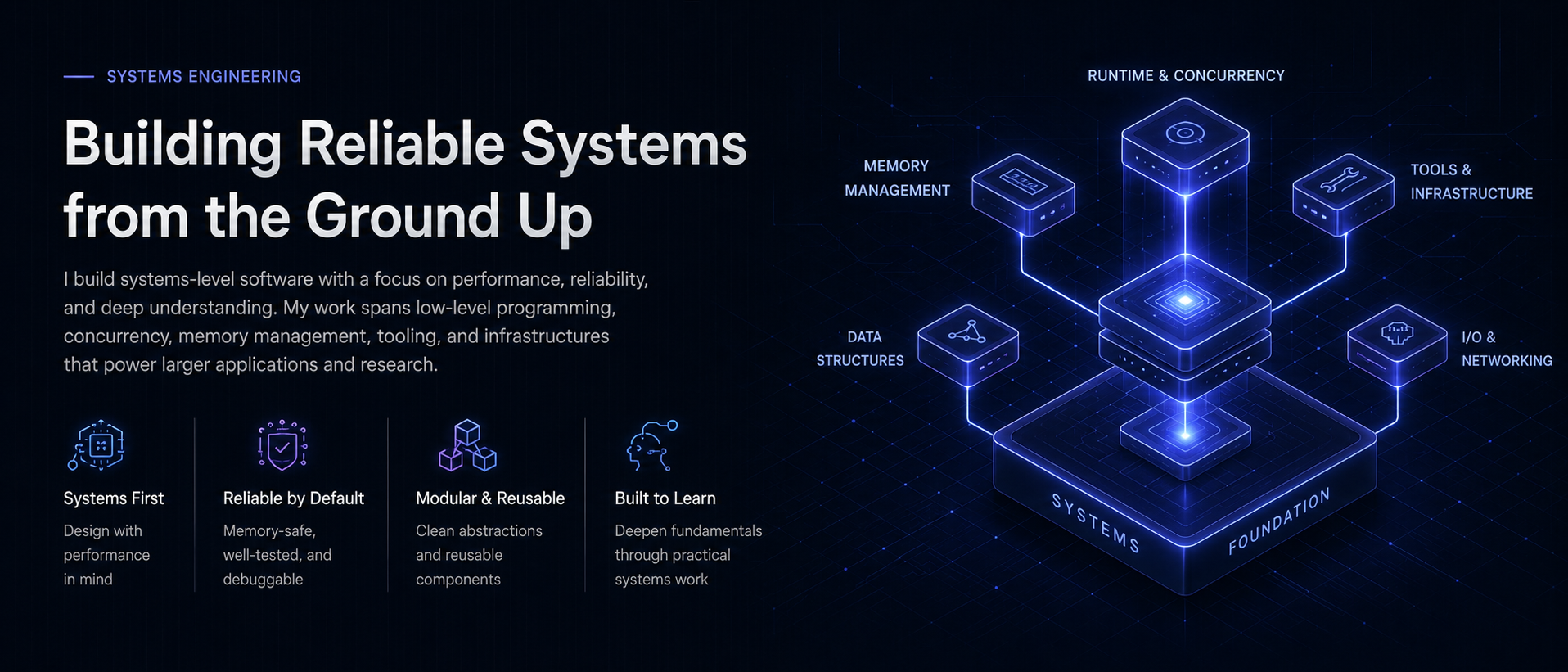
Core Areas
The technical areas I am developing through structured study, hands-on implementation, reusable systems projects, testing, debugging, and progressively deeper low-level work.
Low-Level Programming
C and C++ programming, pointers, arrays, memory layout, bit-level operations, modular interfaces, compilation, debugging, and direct interaction with machine-level behavior.
Memory & Resource Management
Stack and heap behavior, allocation and deallocation, ownership, lifetime, resource cleanup, memory errors, leak detection, and increasingly allocator-aware design.
Concurrency & Parallelism
Processes, threads, synchronization, shared-state reasoning, race conditions, producer-consumer patterns, thread pools, asynchronous execution, and parallel performance.
Systems & OS Concepts
Processes, files, system calls, signals, permissions, inter-process communication, virtual memory, scheduling, Linux interfaces, and operating-system abstractions.
Data Structures & Algorithms
Implementing arrays, linked structures, stacks, queues, trees, hash tables, graphs, searching, sorting, complexity analysis, and performance-conscious algorithm selection.
Tools & Dev Infrastructure
Build systems, Make and CMake, compilers, warning-driven development, testing frameworks, debugging tools, profiling, automation, command-line tooling, and reproducible workflows.
Systems Projects
A growing portfolio of low-level projects built to strengthen memory understanding, operating-system concepts, reusable architecture, performance reasoning, and the foundations required for compiler and runtime engineering.
C Systems Mastery
A structured progression of modular C projects covering input safety, arrays, pointers, memory, debugging, testing, build systems, data structures, and increasingly deeper systems interfaces.
C CLI Lab
A suite of Unix-inspired command-line utilities implemented in C, including echo, cat, grep, sort, diff, file operations, and search tools with emphasis on correctness and reusable design.
MetricForge
A performance-oriented C++ metrics library with Python bindings, clean public interfaces, CMake-based builds, automated testing, and an education-first implementation philosophy.
Memory Tracker
A custom allocation-tracking layer designed to record memory ownership, identify leaks, detect double frees, flag invalid operations, and produce useful diagnostic reports.
Concurrent Thread Pool
A reusable thread-pool library with task submission, worker synchronization, bounded queues, graceful shutdown, error handling, and performance measurement.
Bytecode Virtual Machine
A stack-based virtual machine with bytecode instructions, execution frames, value representation, memory management, control flow, function calls, and a future compiler frontend.
Tooling & Technologies
The languages, compilers, build systems, debuggers, diagnostic tools, and platforms I use to develop and validate systems software.
Languages, Build & Diagnostics
Platforms
Development Environment
A consistent workflow for compiling, testing, debugging, profiling, documenting, and validating systems projects.
$ make clean && make
Build completed with warnings enabled.

$ make test
All tests passed.

$ valgrind --leak-check=full ./build/app
0 bytes definitely lost.

$ git status
Working tree clean.
I use warning-driven compilation and repeatable build commands so that each project can be rebuilt, tested, inspected, and documented consistently across Windows, WSL, and Linux.
Build cleanly: enable strict compiler warnings and keep build configuration reproducible.
Test behavior: verify normal cases, boundaries, invalid input, and failure paths.
Inspect correctness: use debuggers, sanitizers, and memory-analysis tools.
Document and version: preserve commands, design decisions, tests, and verified milestones in Git.
My Approach
I treat systems development as a disciplined learning and engineering process: understand the machinery, implement carefully, validate behavior, improve the design, and preserve what was learned.
Understand Deeply
I begin by building a mental model of how the mechanism works: memory layout, data flow, invariants, ownership, control flow, interfaces, failure modes, and operating-system interaction.
Build Incrementally
I divide the work into focused modules and implement one verifiable behavior at a time. Each step should compile, run, expose a clear interface, and establish a foundation for the next.
Test & Measure
I verify normal behavior, edge cases, invalid inputs, and failure paths. I use warnings, tests, debuggers, sanitizers, memory tools, and measurements to replace assumptions with evidence.
Refactor & Improve
Once behavior is correct, I improve naming, module boundaries, error handling, ownership rules, portability, reuse, performance, and maintainability without changing verified behavior.
Document & Share
I preserve architecture, commands, examples, test results, mistakes, design decisions, and lessons learned so that the work remains reproducible and useful to both future me and others.
Looking Ahead
I am building a strong foundation in C, C++, memory, operating systems, concurrency, performance, and low-level architecture with the long-term goal of contributing to compilers, runtimes, and infrastructure that make software faster, safer, more reliable, and easier to understand.
View Systems RoadmapCompilers & Runtimes
Building and understanding parsers, intermediate representations, optimizers, virtual machines, execution engines, memory systems, and runtime services.
Long-term specializationPerformance Engineering
Measuring latency, throughput, memory behavior, cache effects, parallel scaling, bottlenecks, and the cost of implementation choices.
Growing capabilitySystems Research
Connecting experimental rigor with systems design, performance evaluation, reproducible infrastructure, and practical engineering impact.
Research-to-systems bridgeOpen-Source Contribution
Publishing reusable tools, educational implementations, documentation, tests, examples, research infrastructure, and systems knowledge for the wider community.
Continuous portfolio growth